



Diwali brings light, sweets and family time. It also brings a predictable rise in hospital visits. Doctors see firecracker burns, asthma flare-ups from heavy smoke, stomach infections from spoiled sweets and sugar spikes after days of festive eating.
The numbers show why this matters. The World Health Organization estimates that burns cause around 180,000 deaths every year, and it links air pollution to roughly 7 million premature deaths worldwide.
The good news: most Diwali problems are preventable. These Diwali health tips cover:
- Firecracker safety and first aid for burns
- Protection from smoke, noise and asthma triggers
- Food safety and food poisoning prevention
- Heart health and diabetes management during the festival
Read on, and plan a Diwali that ends in laughter, not in the emergency room.
Diwali Safety Tips: How to Prevent Firecracker Injuries
Firecrackers cause most festival injuries, and most of those injuries are avoidable. Treat every cracker like a small explosive, because that is exactly what it is. Here is how to celebrate Diwali safely and keep firecracker injuries away from your family.
Fire Safety at Home
- Light crackers outdoors, in an open space, away from buildings, vehicles and dry grass.
- Keep two buckets of water and one of sand within reach before you light the first cracker.
- Use a long incense stick or a candle lighter. Never hold a cracker in your hand while it burns.
- Wear fitted cotton clothes. Synthetic fabrics and loose dupattas catch fire fast.
- Never light crackers inside a bottle, tin or any closed container.
- Never relight a dud. Wait, then soak it in water.
- Keep diyas and candles away from curtains, and never leave them burning unattended.
- Choose certified green crackers, skip joined “series” crackers and follow the burst timings announced by the Tamil Nadu government and local police.
Diwali Safety Tips for Children
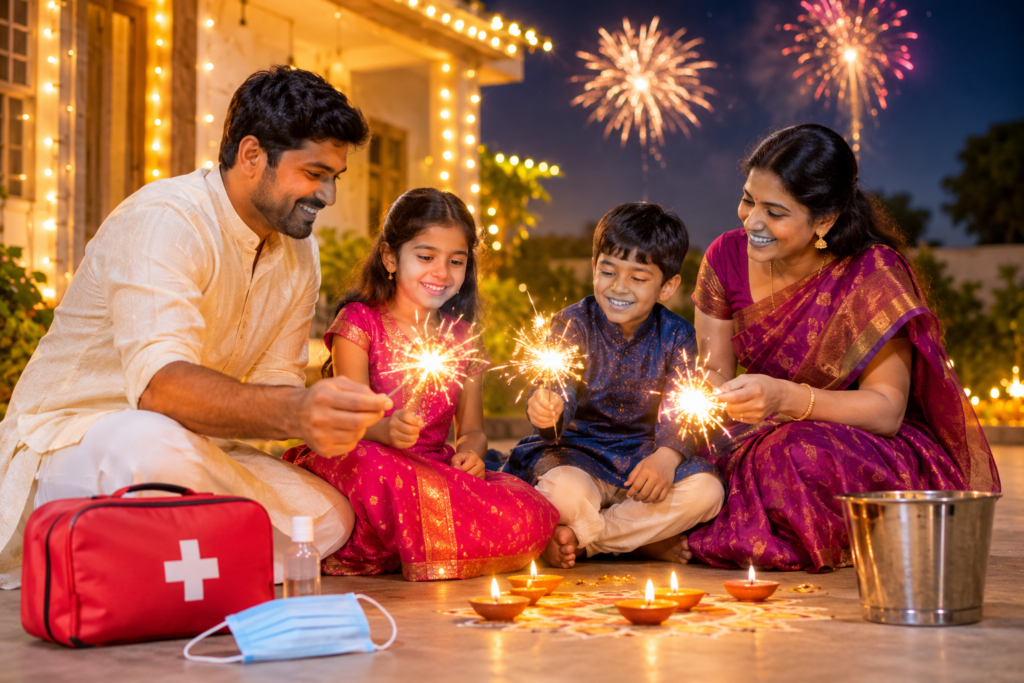
Children love sparklers and fountains, but their skin is thinner and burns deeper. Keep these rules simple and firm:
- An adult must supervise every child, every time.
- Children should never hold, carry or pocket crackers.
- Let them hold sparklers at arm’s length, one at a time, while wearing closed footwear. Drop used sparklers into a bucket of water, because they stay dangerously hot for minutes.
- Keep infants and toddlers indoors, away from loud noise and smoke.
If your child has a burn, a breathing problem or a persistent cough after the festival, our pediatrics team can help.
First Aid for Burns: What to Do in the First Few Minutes
Speed matters when someone gets burned. Cool the burn first, then call for help. Follow these steps:
- Move the person away from the fire or the source of the burn.
- Remove rings, watches and tight clothing near the burn before swelling starts. Do not pull off cloth that sticks to the skin.
- Cool the burn under clean, running tap water for 20 minutes. This stops the burn from going deeper and eases the pain.
- Cover the area loosely with a clean, non-fluffy cloth or cling film.
- Keep the person warm and calm, then call 108 or head to the nearest emergency department.
| Do | Do not |
| Use cool running water for 20 minutes | Apply ice, toothpaste, butter, oil or turmeric |
| Cover with a clean, loose cloth | Burst blisters |
| Remove jewellery before swelling begins | Pull off stuck clothing |
| Get medical help quickly | Wait to see if it “settles on its own” |
Our general surgery team treats burns and wound injuries, and early treatment gives the best chance of healing with minimal scarring.
Go Straight to Emergency Care If
- The burn is larger than the person’s palm
- It affects the face, hands, feet, joints or genitals
- The skin looks white, charred or leathery, or the person feels no pain in the area
- A child or an older adult is burned
- A cracker has injured the eye. Do not rub or rinse it. Cover it with a clean cup or eye shield and see an eye specialist immediately.
How to Protect Yourself From Diwali Air Pollution
Cracker smoke releases fine particles that reach deep into the lungs. People with asthma, COPD, heart disease, young children and older adults feel it first. These steps help you protect yourself from Diwali air pollution:
- Check the air quality index before you plan outdoor time, and avoid the late evening hours when smoke settles.
- Close windows during peak bursting hours. Run a HEPA air purifier if you own one.
- Wear a well-fitted N95 mask outdoors. Cloth and loose surgical masks filter very little fine smoke.
- Keep your reliever inhaler within reach and take your controller medicines on schedule. If you have asthma, do not wait for symptoms to start before you act.
- Skip outdoor exercise the morning after heavy smoke. Drink plenty of water.
See a doctor if you have wheezing, chest tightness, breathlessness or a cough that does not settle, especially if your inhaler stops helping. Our pulmonology team manages asthma, COPD and festival-season breathing problems.
Noise Pollution: Protect Your Ears and Your Heart
The Central Pollution Control Board caps firecracker noise at 125 decibels measured at 4 metres, while the daytime limit in residential areas is just 55 decibels. A close-range blast can damage hearing instantly, and sudden bangs can push up heart rate and blood pressure.
- Stand well back from every cracker and use earplugs or earmuffs if you are close.
- Keep infants, older adults and people with heart disease indoors during heavy bursting.
- Do not ignore ringing, muffled hearing or ear pain after the festival. See an ENT specialist if it lasts more than a day.
Food Safety During Diwali: How to Avoid Food Poisoning
Festive kitchens run non-stop, and Chennai’s warm, humid weather helps bacteria multiply quickly. Milk-based sweets, khoya, cream and fresh coconut spoil fast. Here is how to maintain food safety during Diwali:
- Buy sweets from trusted shops, and check the date, colour and smell.
- Refrigerate milk-based sweets. Do not leave any cooked food out for more than two hours.
- Wash your hands before you cook and before you eat. Wash them after bursting crackers too, because gunpowder residue stays on your fingers.
- Do not reuse frying oil again and again. It adds to acidity and indigestion.
- Cook snacks fully, keep raw and cooked foods apart and drink safe water.
Food poisoning shows up as vomiting, loose stools, stomach cramps and fever. Sip oral rehydration solution (ORS) and fluids. See a doctor if symptoms last more than a day, if there is blood in the stool, or if you notice signs of dehydration such as dry mouth, little urine or dizziness. Children and older adults should get help sooner. Our medical gastroenterology and general medicine teams can help.
Heart Health and Diabetes Management During Diwali
Heart Health
Heavy meals, extra salt, oily snacks, alcohol, smoke, noise and late nights all put extra load on the heart. Keep your routine steady:
- Take your blood pressure and heart medicines on time, even on the busiest day.
- Eat smaller portions and avoid heavy meals late at night.
- Walk for 10 to 15 minutes after meals.
- Stay away from smoke and loud blasts if you have heart disease.
Chest pain or pressure, pain spreading to the arm or jaw, sweating or sudden breathlessness is an emergency. Call 108 or go to the nearest hospital immediately. Do not wait for the festival to end. Our cardiology team is here to help.
Diabetes Management
The ICMR-INDIAB study, published in The Lancet Diabetes & Endocrinology in 2023, estimated that about 101 million people in India live with diabetes. For them, Diwali sweets are a real challenge. A few simple habits make the festival easier:
- Do not skip meals to “save room” for sweets. Skipping meals leads to sugar swings.
- Choose one small portion of one sweet, and eat it after a balanced meal.
- Remember that sugar-free sweets still carry carbohydrates from dates, nuts and khoya.
- Check your blood sugar more often during the festival week, and keep fast-acting sugar handy for lows.
- Take insulin and tablets on time, even when you travel or visit relatives.
- Look at your feet daily for cuts and burns.
Our diabetology team can help you plan a safe festival and review your treatment.
Quick Diwali Health Checklist
| Concern | What to do | See a doctor if |
| Burns | Cool under running water for 20 minutes, cover loosely | Burn is large, deep, on the face or hands, or a child is hurt |
| Asthma and smoke | Keep your inhaler ready, wear an N95 mask, stay indoors at peak smoke hours | Wheezing or breathlessness does not ease with your inhaler |
| Food poisoning | Fresh food, clean hands, ORS and fluids | Symptoms last over a day, blood in stool, or signs of dehydration |
| Noise | Keep your distance, use ear protection | Ringing or muffled hearing lasts more than a day |
| Heart health | Take medicines on time, eat lighter, avoid heavy exertion | Chest pain, pressure or sudden breathlessness (call 108) |
| Diabetes | Regular meals, small portions, frequent sugar checks | Very high or very low sugar readings, or unusual drowsiness |
Emergency Care Near You: Hospital Near Sholinganallur, Siruseri and Kelambakkam
Even with careful planning, accidents happen. If you live or work along OMR, Supreme Speciality Hospitals in Padur is easy to reach from Sholinganallur, Siruseri and Kelambakkam. As an emergency care hospital in Chennai, we bring specialists in general surgery, pulmonology, cardiology, pediatrics, ENT, ophthalmology and general medicine under one roof. Our team is available round the clock, so you are covered if you need a 24 hours hospital stay in Chennai on festival night.
Save the hospital’s contact number and 108 on your phone before the festival begins. Planning a check-up after the celebrations? Explore our health check-up packages.
Frequently Asked Questions
What are the most important Diwali health tips?
Burst only green crackers outdoors with adult supervision, keep water and sand nearby, wear a mask in smoky air, eat fresh food, take your regular medicines on time and know where your nearest emergency hospital is.
How can I celebrate Diwali safely with children?
Keep children at a safe distance, wear cotton clothes and closed footwear, let them use only sparklers or fountains under adult supervision, and keep buckets of water close by. Never let a child carry crackers in a pocket.
What is the first aid for burns from firecrackers?
Cool the burn under clean, running water for 20 minutes, remove rings and tight items, cover it loosely with a clean cloth and seek medical help. Do not use ice, toothpaste, butter or oil.
How do I protect myself from Diwali air pollution if I have asthma?
Stay indoors during peak smoke hours, wear a fitted N95 mask outside, keep your reliever inhaler within reach and continue your controller medicines. See a doctor if breathlessness or wheezing does not improve.
How can I avoid food poisoning from Diwali sweets?
Buy from trusted shops, refrigerate milk-based sweets, never leave cooked food out for over two hours and wash your hands before eating, especially after handling crackers.
Can people with diabetes enjoy Diwali sweets?
Yes, in small portions after a balanced meal, with regular sugar checks and medicines taken on time. Sugar-free sweets still contain carbohydrates, so portion size matters.
Is there an emergency care hospital near Sholinganallur and Kelambakkam?
Yes. Supreme Speciality Hospitals in Padur, on OMR, offers emergency care and multispeciality treatment for families across Sholinganallur, Siruseri and Kelambakkam.
Conclusion
A safe Diwali does not need a long list of rules. It needs a few smart habits: keep a safe distance from crackers, know the first aid for burns, protect your lungs and ears, eat fresh food and take your regular medicines on schedule. These Diwali health tips protect your family so you can enjoy the lights, the sweets and the laughter without a hospital visit.
Happy Diwali! Celebrate safely and stay healthy. Warm wishes from Supreme Speciality Hospitals, Padur, OMR, Chennai.
Medical disclaimer: This article offers general health information and does not replace advice from a qualified doctor. In an emergency, call 108 or visit your nearest hospital.