



Medically Reviewed By: Dr. R. Gokul and Dr. Yuwarani. M, Department of Dermatology, Supreme Hospitals, Padur, Chennai.
Pimples on your face have a way of showing up before a big meeting, an exam or a family function. The good news is that most breakouts have clear causes. Once you understand the reasons for pimples on your face, you can treat them with the right steps instead of guessing.
Acne is far more common than most people think. The American Academy of Dermatology says it affects up to 50 million Americans every year. In this guide, you will learn:
- Why pimples come on face and what triggers them
- How hormonal pimples and period pimples differ from other breakouts
- Which skin habits help and which ones make things worse
- When to see a skin specialist in Padur or elsewhere on OMR
Let’s start with what happens under your skin.
What Are the Main Reasons for Pimples on Face?
A pimple forms when a pore gets blocked. Your skin makes an oily substance called sebum to stay soft. Normally, sebum travels up the pore and out onto the surface. Sometimes dead skin cells mix with that oil and plug the opening. That plug is the start of every pimple.
Three things then work together:
- Excess oil. Your oil glands make more sebum than the pore can clear.
- Clogged pores. Dead skin cells and oil build up and form a plug.
- Bacteria and inflammation. Acne-causing bacteria grow inside the blocked pore, and your body reacts with redness and swelling.
Think of a narrow road during rush hour. A few cars move through easily, but once the road clogs, everything backs up. That swelling is why some breakouts on the face feel sore and look red, while others stay flat and painless.
So the real reasons for pimples on the face are rarely about dirt alone. Washing your face five times a day will not fix a clogged pore, and harsh scrubbing can make the irritation worse. Knowing this first step helps you choose treatments that match what is actually happening in your skin.
Why Pimples Come on Face: Everyday Triggers
Blocked pores explain how a pimple forms. These triggers explain why it keeps happening to you:
- Hormones. Changes in androgen levels raise oil production. That is why breakouts often start in puberty and return around periods, pregnancy or stressful phases.
- Stress. When you feel under pressure, your body releases more cortisol, and that can push your oil glands harder.
- Skin care and makeup. Heavy creams, oils and some cosmetics can clog pores. Over-scrubbing or using harsh toners strips your skin and can trigger even more oil.
- Diet. Some people notice more breakouts after sugary or high-glycemic foods. The link is not the same for everyone, so track what you eat for a few weeks before you cut anything out.
- Heat, humidity and sweat. Chennai’s humid weather can leave your skin oily by afternoon, especially if you commute through traffic.
- Genetics. If your parents had stubborn acne, you may too.
- Medicines. Some medicines, including certain steroids, can trigger acne. Never stop a prescribed medicine on your own. Ask your doctor first.
- Picking and squeezing. This pushes bacteria deeper and raises your chance of dark marks.
If several of these sound familiar, that is normal. Most people have a mix of triggers, not just one.
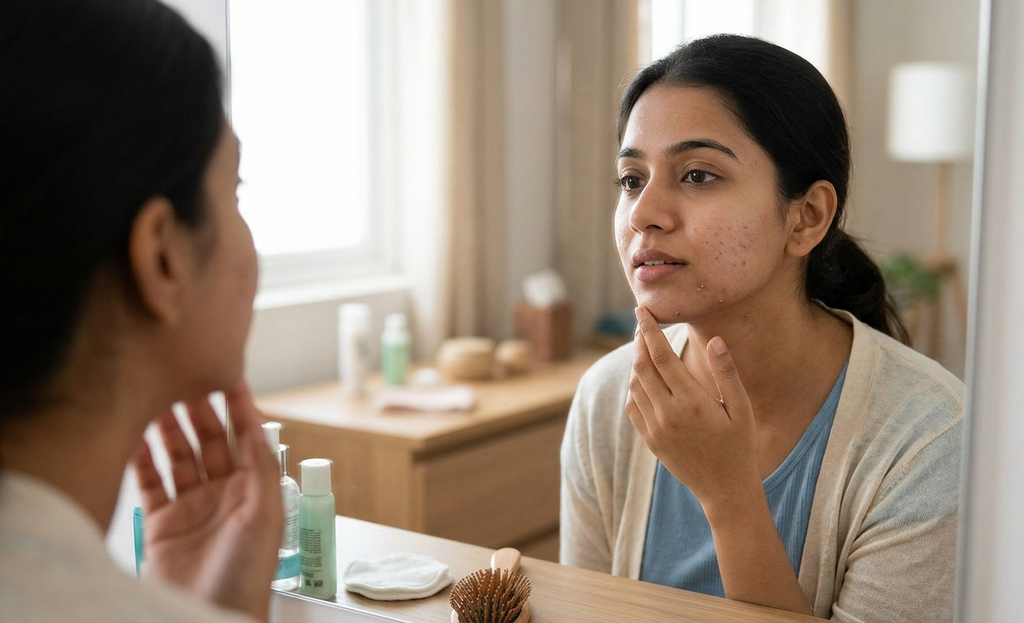
Hormonal Pimples and Period Pimples
Hormonal pimples have a signature pattern. They show up along the jawline, chin and lower cheeks, and they tend to feel deep, tender and slow to heal.
Hormones affect your oil glands directly. When hormone levels shift, your skin makes more sebum, and pores clog more easily. That is why many women notice a period pimple, or a cluster of breakouts before period, in the days before bleeding starts. The same pattern can appear around ovulation, during pregnancy, and after you start or stop birth control.
Here are signs that hormones may play a bigger role in your breakouts:
- Pimples cluster around the chin and jawline.
- Flare-ups follow a monthly pattern.
- Breakouts come with irregular periods.
- You notice extra hair growth on the face or body.
- Acne keeps coming back after treatment.
If you tick more than one of these, speak to a doctor about PCOS (polycystic ovary syndrome). PCOS raises androgen levels, and acne often will not settle until the underlying condition gets treated. A simple consultation, and sometimes a blood test, can give you clarity. Tracking your breakouts on a calendar for two or three cycles also gives your dermatologist useful information.
Types of Pimples: Pustules, Whiteheads, Blackheads and Cysts
Not every pimple needs the same treatment, so it helps to know what you are looking at.
| Type | What it looks like | How it feels |
| Blackheads | Small dark dots on open pores | Flat, usually painless |
| Whiteheads | Small white or skin-coloured bumps under a closed pore | Slightly raised, mild |
| Papules | Small red or pink bumps | Tender to touch |
| Pustules | Red bumps with a white or yellow tip | Sore, sometimes throbbing |
| Nodules and cysts | Large, deep lumps under the skin | Painful, can last for weeks |
Pustules are one of the most searched pimple types, and the urge to squeeze them is strong. Please resist. Squeezing a pustule pushes pus and bacteria deeper into the skin. A small spot can then become a big pimple on face that lasts for weeks and leaves a mark.
Whiteheads and blackheads often respond to gentle ingredients like salicylic acid. Deeper nodules and cysts do not. Creams from the shop shelf rarely reach that depth, and these lumps carry the highest risk of scarring. If you see them, book a skin check instead of waiting them out.
Pimples on Cheeks, Chin and Body: What Each Area Tells You
Where a pimple appears can give clues about its cause. Use this table as a starting point, not a diagnosis.
| Area | Common reasons | What may help |
| Cheeks | Phones, pillowcases, touching the face, hair products, heat | Clean your phone daily, change pillowcases weekly, keep your hands off |
| Chin and jawline | Hormonal shifts, PCOS, picking, friction from masks or hands | Track flare-ups against your cycle, see a dermatologist if lumps run deep |
| Forehead | Hair oils, styling products, helmets, headbands | Keep hair products off your skin, wash after wearing a helmet |
| Chest and shoulders | Sweat, tight clothing, heavy lotions, hormones | Shower after you sweat, wear breathable fabrics |
The causes of pimples on cheeks are usually simple. Phone screens, pillowcases and hands carry oil and bacteria all day. If you keep asking why am I getting pimples on my cheeks, start by cleaning your phone and changing your pillowcase every week.
Chin breakouts deserve a closer look. What causes breakouts on the chin? Most often, hormones. A sudden breakout on the face that centres on the chin usually points that way. Cystic spots on chin, meaning deep and painful lumps with no head, rarely clear on their own.
On the body, sweat and friction do most of the damage. Many women notice pimples on their chest, and both men and women can cause acne on their shoulders with tight synthetic clothes, damp gym wear and heavy body lotions. Shower soon after you sweat and choose breathable cotton.
Why Am I Still Breaking Out in My 30s? Understanding Adult Pimples
Many people expect acne to disappear after school. It often does not. A study published in the Journal of the American Academy of Dermatology found that 45% of women aged 21 to 30 and 26% of women aged 31 to 40 had clinical acne. Even among women aged 41 to 50, 12% did.
So if you are asking why I am still breaking out in my 30s, you are in a large company. Adult pimples differ from teenage ones. They sit more often on the lower face, feel deeper and heal more slowly. Your skin also renews itself more slowly with age, so dead cells stay on the surface longer and block pores. The causes of pimples on the face in adults are rarely single. Stress, long work hours, poor sleep, hormones and new products often stack up together.
Men get adult pimples too. Face pimples in men often link to shaving irritation, sweat and oily skin. Many men ignore them, and that delay lets inflammation turn into scars. Shaving can also cause ingrown hairs that look like pimples, so a doctor’s eye helps tell the two apart.
If your skin is breaking out suddenly after months of calm, think about what changed. A new cream, a stressful month, a new medicine or a hormonal shift is usually behind it. A plan built around your skin works better than swapping products at random.
Skin Care Habits That Actually Help
Good habits will not cure every pimple, but they give any treatment a better chance. Keep your routine simple:
- Wash twice a day with a mild cleanser. Over-washing and scrubbing strip your skin and can trigger extra oil.
- Moisturise, even if your skin is oily. Skipping moisturiser can damage your skin barrier and make breakouts worse. Look for a non comedogenic moisturiser for acne, which means the formula is made not to clog pores. Gel or water-based types suit most oily skin.
- Use sunscreen every morning. Choose a light, non comedogenic one. Sun exposure makes dark marks darker.
- Add one active at a time. Low-strength salicylic acid or benzoyl peroxide can help mild breakouts. Introduce a new product slowly, and ask a doctor before you start a retinoid.
- Leave your pimples alone. Picking is the quickest route to scarring.
- Give it time. Most new routines need six to eight weeks before you can judge them.
Pay attention to the marks pimples leave behind. Dark patches after a breakout have a medical name: post inflammatory hyperpigmentation. They are not scars, but they can take months to fade, and sun exposure deepens them. Daily sunscreen and early treatment of active pimples are the best ways to prevent them.
When to See a Dermatologist
Home care works for mild breakouts. It stops working when pimples get deep, painful or stubborn. See a dermatologist if you notice any of these:
- Deep, painful lumps or cystic spots that last more than a few weeks
- Pimples that leave scars or dark marks
- No improvement after six to eight weeks of a steady routine
- Breakouts along with irregular periods or excess facial hair
- Acne that affects your confidence, sleep or mood
Early treatment protects your skin. Untreated acne can leave permanent scars and dark spots, and it can weigh on your mood too.
If you are searching for a dermatologist in OMR Chennai, the dermatology department at Supreme Hospitals in Padur offers skin and hair treatment and advanced laser therapies. The team serves patients across OMR, including Navalur, Kelambakkam and Sholinganallur, so a skin doctor near Navalur is closer than you may think. Our dermatologists look at your skin type, triggers and medical history before they suggest a plan. You can book an appointment in a few minutes through the Supreme Hospitals website.
Frequently Asked Questions
What are the main reasons for pimples on the face?
Blocked pores cause most pimples. Excess oil, dead skin cells and bacteria build up inside a pore, and your skin reacts with inflammation. Hormones, stress, skin care products, diet, genetics and friction can all trigger that process.
Why do pimples occur on the face before periods?
Hormone levels shift in the days before your period, and your oil glands respond by making more sebum. That extra oil blocks pores, which is why breakouts before period often appear on the chin and jawline.
Are big pimples on the face and cystic spots dangerous?
They are not dangerous, but they can leave scars and dark marks. Deep lumps rarely respond to shop-bought creams, so see a dermatologist rather than squeezing them.
How long does pimple treatment take to work?
Mild breakouts usually need six to eight weeks of a steady routine before you see a clear change. Deeper or hormonal acne can take longer, and your dermatologist can set realistic expectations after examining your skin.
Is adult acne different from teenage acne?
Yes. Adult acne tends to sit on the lower face, feel deeper and heal more slowly. It often links to hormones and stress, while teenage acne links more to puberty and an oily T-zone.
Conclusion
Pimples have reasons, and once you know them, they stop feeling random. Blocked pores, hormones, stress, skin care habits and genetics all play a part. The reasons for pimples on your face differ from person to person, which is why a friend’s routine may do nothing for you.
Start with simple habits: gentle cleansing, a non comedogenic moisturiser, daily sunscreen and no picking. If your pimples are deep, painful, scarring or tied to your cycle, do not wait. The dermatology team at Supreme Hospitals in Padur, OMR, can find the cause and build a plan for your skin. Book your appointment today and take the guesswork out of clear skin.
About the Authors
Dr. R. Gokul, MBBS, MD (DVL), DNB (DVL)
Dr. R. Gokul is a skin and hair treatment specialist at Supreme Hospitals, Padur. His work focuses on advanced laser treatments and cosmetology, and he helps patients with a wide range of skin and hair concerns. He believes good skin care starts with finding the cause, not just treating the spot. Book an appointment with Dr. R. Gokul.
Dr. Yuwarani. M, MBBS, MD Dermatology, Venereology & Leprosy
Dr. Yuwarani. M is a dermatologist at Supreme Hospitals, Padur, with a focus on skin and hair treatment and advanced laser therapies. She takes time to explain each treatment plan so patients know what to expect at every step. Book an appointment with Dr. Yuwarani. M.
Medical Disclaimer: This article is for general information and does not replace advice from a qualified doctor. Please consult a dermatologist for diagnosis and treatment.