



Back pain after a long day at your desk is easy to ignore. Back pain that shoots down your leg, or leaves your foot tingling, is not. The World Health Organization reports that low back pain affected 619 million people worldwide in 2020, about 1 in 13 people. Not every case is a simple muscle strain. Sometimes a disc is the cause.
Slipped disk symptoms often start quietly, then grow harder to dismiss. This guide helps you spot them early. You will learn:
- How to tell a slipped disc from ordinary back pain
- Which warning signs need an orthopaedic doctor this week
- Which signs need emergency care today
- What treatment looks like, and whether surgery is likely
Read on, and you will know exactly when to wait, when to book, and when to go straight to the hospital.
What Is a Slipped Disk?
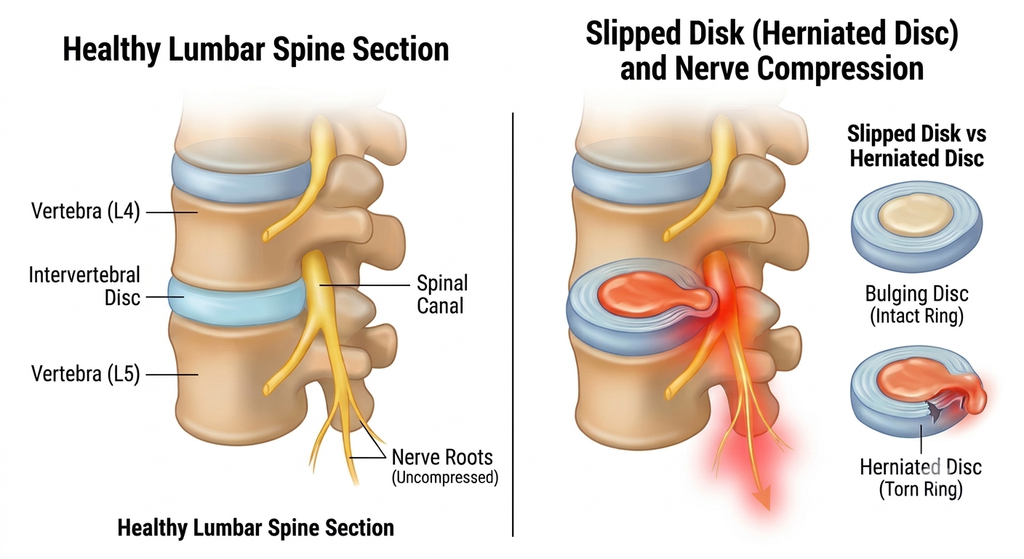
Your spine is a stack of bones called vertebrae. Between each pair sits a disc, a rubbery cushion with a tough outer ring and a soft, jelly-like centre. These discs absorb shock every time you walk, bend or lift.
So what is a slipped disk? The name suggests a disc that slides out of place, but that is not quite what happens. The disc stays between the bones. Its soft centre pushes through a weak spot in the outer ring and can press on a nearby nerve. The nerve then reacts with pain, tingling or weakness.
Slipped Disc vs Herniated Disc
In everyday use, slipped disc and herniated disc mean the same thing. Doctors usually say herniated disc or prolapsed disc, while patients say slipped disc. Some doctors separate a bulging disc (the outer ring stretches but stays intact) from a herniated disc (the ring tears and the centre leaks out). Both can cause symptoms, and both start with similar treatment.
Keep these points in mind:
- A slipped disc can happen anywhere in the spine, but the lower back and neck are the most common sites
- Not every slipped disc causes pain. Some people only find out on an MRI scan
- The location of the disc decides where you feel the symptoms
Slipped Disk Symptoms You Should Not Ignore
So, what are the symptoms of a slipped disc? They vary from person to person, but these seven signs show up most often:
Lingering lower back pain. It feels deep or aching and does not ease with a day or two of rest.
Pain that travels down the leg. Doctors call this sciatica. It runs from the buttock to the thigh, calf or foot and often feels sharp or burning.
Numbness or tingling. You may notice pins and needles in the foot, leg, arm or hand.
Muscle weakness. Your foot may drag, your grip may loosen, or your leg may give way on stairs.
Pain that flares when you cough, sneeze or bend. These actions raise pressure inside the spine and squeeze the irritated nerve.
Pain that worsens with sitting. Many people feel better walking or lying down than sitting for an hour.
Stiffness and muscle spasms. Your back tightens to protect the injured area, which makes it hard to bend or twist.
Here is an example. Say you lift a heavy water can on Saturday. By Monday your lower back aches, and by Wednesday a burning pain runs from your buttock to your calf. That pattern points to a disc, not a pulled muscle. A slipped disc also tends to affect one side of the body more than the other.
One symptom matters more than the rest: weakness. Pain tells you something is wrong. Weakness tells you a nerve is struggling, and that is when you should call a doctor.
Slipped Disc in the Lower Back vs the Neck
Where you feel the pain tells you where the problem sits. This table shows the usual pattern:
| Disc location | Where you feel it | Common symptoms |
| Lower back (lumbar) | Back, buttock, leg, foot | Sciatica, burning pain, numb foot, weak ankle, pain when sitting |
| Neck (cervical) | Neck, shoulder, arm, hand | Arm pain, tingling fingers, weak grip, stiff neck |
| Mid back (thoracic) | Between the shoulder blades, around the ribs | Band-like pain, less common |
Slipped disk lower back symptoms
A slipped disc in the lower back is the most common type. Your lumbar discs carry most of your body weight, and the two lowest levels take the greatest load. That is why slipped disk lower back symptoms usually include leg pain along with back pain. If you feel pain below the knee, or numbness in your foot, a lumbar disc is a likely suspect. Neck discs behave differently. They send pain into the shoulder and arm, and they can make your fingers tingle while you work at a laptop.
What Causes a Slipped Disc?
What causes a slipped disc? Usually a mix of slow wear and a sudden strain. Discs lose water and flexibility as you age, so the outer ring cracks more easily. Then one wrong movement finishes the job.
Common causes and risk factors include:
- Age. Discs dry out and weaken, most often after your 30s
- Lifting with a rounded back. Picking up a heavy bag or gas cylinder without bending your knees puts huge pressure on lower discs
- Sudden twisting. A fast turn while carrying a load, or a sports injury, can tear the outer ring
- Long hours of sitting. Desk jobs and long commutes load your lower back for hours
- Weak core muscles. Weak abdominal and back muscles leave your discs to do all the work
- Excess body weight. More weight means more load on every disc
- Smoking. It reduces the blood supply that keeps discs healthy
- Family history. Some people inherit weaker discs
Picture a 38-year-old who sits for nine hours a day, skips exercise, then lifts a heavy suitcase onto a train rack. No single habit caused the injury. Together they did.
When Should You Consult an Orthopaedic Doctor?
Most back pain settles on its own. A slipped disc often does not, and some signs need quick action. Use this table as a guide:
| What you notice | What to do |
| Back pain that is easing and has no leg or arm symptoms | Stay gently active and watch for a week |
| Back pain that has not improved after 1 to 2 weeks | Book an orthopaedic consultation |
| Pain, numbness or tingling in a leg or arm | Book within a few days |
| Foot drop, weak grip, or a leg that gives way | See a doctor the same day or the next day |
| Back pain after a fall or accident, or with fever or unexplained weight loss | See a doctor promptly |
| Loss of bladder or bowel control, numbness around the groin or inner thighs, or weakness in both legs | Go to the emergency department now |
Book an appointment soon
If you have leg or arm pain, numbness, or pain that keeps you awake at night, do not wait for it to pass. A spine specialist can find the cause early and start treatment before the nerve takes more damage. Early care often means simpler treatment.
Go to the emergency department now
A large disc herniation can press on the bundle of nerves at the base of the spine. This is called cauda equina syndrome. It is rare, but it is an emergency. If you cannot control your bladder or bowels, feel numb in the saddle area, or notice weakness spreading in both legs, go to the hospital immediately. Do not book a routine visit.
How Is a Slipped Disc Diagnosed?
Your orthopaedic doctor starts by listening. They ask where the pain begins, what makes it worse, and how it affects your day. Then they examine you. They check your reflexes, muscle strength, sensation and walking pattern. A simple leg raise test shows whether the sciatic nerve is irritated.
Imaging comes next, if needed:
- X-ray. It shows the bones and rules out fractures or other causes, but it cannot show the disc itself
- MRI scan. It shows the discs, nerves and spinal canal in detail, so it is the most useful test for a suspected slipped disc
- Nerve tests. These help when the doctor needs to confirm which nerve is affected
One caution: an MRI finding must match your symptoms. Many people have disc bulges on a scan and no pain at all. A good spine specialist treats you, not the picture.
Slipped Disc Treatment, Pain Relief and Recovery Time
Here is the good news. Orlando Health notes that 80 to 90 percent of disc herniations are treated without surgery. Slipped disc treatment starts gently and moves up only if needed.
Can a slipped disc heal without surgery?
Yes, in most cases. Over time the inflammation settles and the pressure on the nerve eases. Treatment helps you through that window:
- Medicines. Your doctor may prescribe pain relievers, anti-inflammatory tablets or nerve pain medicines
- Physiotherapy. A therapist teaches exercises that strengthen your core and improve flexibility
- Injections. An epidural steroid injection can calm a badly inflamed nerve
- Minimally invasive surgery. Doctors consider this when you have worsening weakness, nerve damage, or pain that stays severe despite weeks of treatment
How long does a slipped disc take to heal?
Many people feel noticeably better within a few weeks. Full recovery can take a few months. Your age, the disc level, and how early you start treatment all affect the timeline.
Slipped disc pain relief at home
These steps help while you wait for your appointment:
- Rest for a day or two, then start walking short distances
- Change position every 30 minutes if you sit for work
- Use a warm pack on stiff muscles
- Avoid heavy lifting and sudden twists
- Skip strong painkillers, steroid tablets and deep massage unless a doctor has examined you first
Spine Care at Supreme Hospitals, Padur, OMR, Chennai
If you are looking for a spine specialist in Chennai, or an orthopaedic hospital in Padur, the orthopedics department at Supreme Hospitals handles back, neck and joint problems from first consultation to treatment.
Patients from Navalur, Siruseri, Kelambakkam and Sholinganallur can reach Supreme Hospitals quickly along OMR. If you are searching for slipped disc treatment in Chennai or an orthopaedic doctor in OMR Chennai, you can book an appointment online and get your symptoms checked before they worsen.
Frequently Asked Questions
What are the first signs of a slipped disc?
The first signs are usually lower back pain that does not ease with rest, followed by pain, tingling or numbness in one leg. Pain often worsens when you sit, cough or bend. If your neck is affected, you may feel pain and tingling in one arm instead.
Can a slipped disc heal on its own?
Yes, many slipped discs improve without surgery. The inflammation settles and the pressure on the nerve eases over time. Medicines and physiotherapy make the wait more comfortable. See a doctor if pain lasts more than a couple of weeks or if weakness develops.
How long does a slipped disc take to heal?
Most people feel better within a few weeks, and full recovery can take a few months. The timeline depends on your age, the disc level and the severity of the herniation. Starting treatment early usually shortens it.
What is the difference between a slipped disc and a herniated disc?
There is no real difference in daily use. Slipped disc is the common name. Herniated disc and prolapsed disc are the terms doctors use. A bulging disc is a milder stage where the outer ring has not yet torn.
Is walking good for a slipped disc?
Short, gentle walks usually help. They keep your muscles active and ease stiffness. Stop if the pain shoots down your leg or if numbness increases, and check with your doctor before starting a new exercise routine.
When should I see a spine specialist in Chennai?
See one if back pain lasts more than 1 to 2 weeks, spreads to your leg or arm, or comes with numbness or weakness. Go to the emergency department at once if you lose bladder or bowel control.
Conclusion
A slipped disc is common, and most people recover without surgery. The trick is knowing when to wait and when to act. Mild back pain that fades in a few days can wait. Leg pain, numbness, tingling or weakness cannot. Loss of bladder or bowel control cannot wait at all.
If your slipped disk symptoms have lasted more than a week or two, get them checked. An early diagnosis protects your nerves and often keeps treatment simple. Speak to the orthopaedic team at Supreme Hospitals, Padur, OMR, and take the first step toward a pain-free back.
About the Authors
Dr. F. Abdul Khader, MBBS, MS Ortho, MCh Ortho
Dr. F. Abdul Khader is a consultant in the orthopedics department at Supreme Hospitals, Padur, Chennai. He is an expert in bone and joint surgery, with a focus on spine care and joint replacement. He holds an MBBS, an MS in Orthopaedics and an MCh in Orthopaedics. He helps patients with back pain, disc problems and joint conditions find a treatment plan that fits their lifestyle.
Dr. Thirumal, MBBS, Dip Ortho, FSS Spine, FMAS
Dr. Thirumal is a spine surgery specialist at Supreme Hospitals, Padur, Chennai. He holds an MBBS, a Diploma in Orthopaedics, an FSS in Spine surgery and an FMAS, and he focuses on minimally invasive joint and spine care. He treats slipped discs, sciatica and other spine problems, with a strong emphasis on careful diagnosis and a quick return to daily life.
Medical disclaimer: This article is for general information only. It does not replace advice from a qualified doctor. If you have back pain with numbness, weakness, or loss of bladder or bowel control, seek medical care immediately.