



It is 2 a.m. The house is quiet, your child feels warm, and the thermometer reads 101°F. Few moments make a parent feel more alone. A child fever at night feels scarier than the same fever at noon, mostly because the clinic is closed and you are not sure what to do next.
Here is what is worth knowing right away:
- Fever is usually the body fighting an infection, most often a viral fever, and not a disease on its own.
- Febrile seizures affect about 2 to 5 percent of children in the US and Western Europe, according to the 5-Minute Pediatric Consult, and most are short and harmless.
- How your child looks and behaves matters more than the number on the thermometer.
This guide explains why fevers rise at night, how to bring your child comfort at home, and which signs mean you should call a doctor.
Why Does a Child’s Fever Rise at Night?
Body temperature naturally rises in the late afternoon and evening, and cortisol levels are often lower at night. When an infection is already active, both changes push the fever higher after sunset.
Why fevers spike in the evening
A fever at night is not your imagination. Your child’s body temperature follows a daily rhythm. When a virus or bacteria is already at work, that normal evening rise lifts the fever further. The immune system is also very active at night while your child tries to sleep.
Daytime hides the rest. At noon, your child is busy and distracted. At 2 a.m., a warm forehead, restless sleep and a silent room make every degree feel louder. That is why many parents search “why do fevers spike at night” at exactly this hour.
Why the fever is gone in the morning
Many parents notice that a child fever at night gone in the morning is a common pattern. The temperature often drops at sunrise, and your child may look cheerful at breakfast. That does not always mean the infection has cleared. Keep checking the temperature for the next two or three evenings.
What Counts as a Fever in Children?
Doctors define fever as a temperature of 100.4°F (38°C) or higher. A reading just below that line is a raised temperature, not a true fever.
Temperature guide by age
| Child’s age | Temperature | What to do |
| Under 3 months | 100.4°F (38°C) or higher | Call a doctor or go to the hospital right away. Do not give medicine unless the doctor says so. |
| 3 to 12 months | 100.4°F (38°C) or higher | Call your pediatrician the same day, especially if the fever lasts over 24 hours or your baby looks unwell. |
| 1 to 12 years | 100.4°F to 103°F | Home care is often enough if your child drinks fluids and stays alert. |
| Any age | 104°F (40°C) or higher | Call a doctor the same day, even if your child seems fine. |
Treat a 100.4 fever in a baby under 3 months as urgent every time. Fever in newborn babies can signal a serious infection, because their immune systems are still developing. A 104 degree fever in any child deserves a call to the doctor, although the number alone does not mean brain damage.
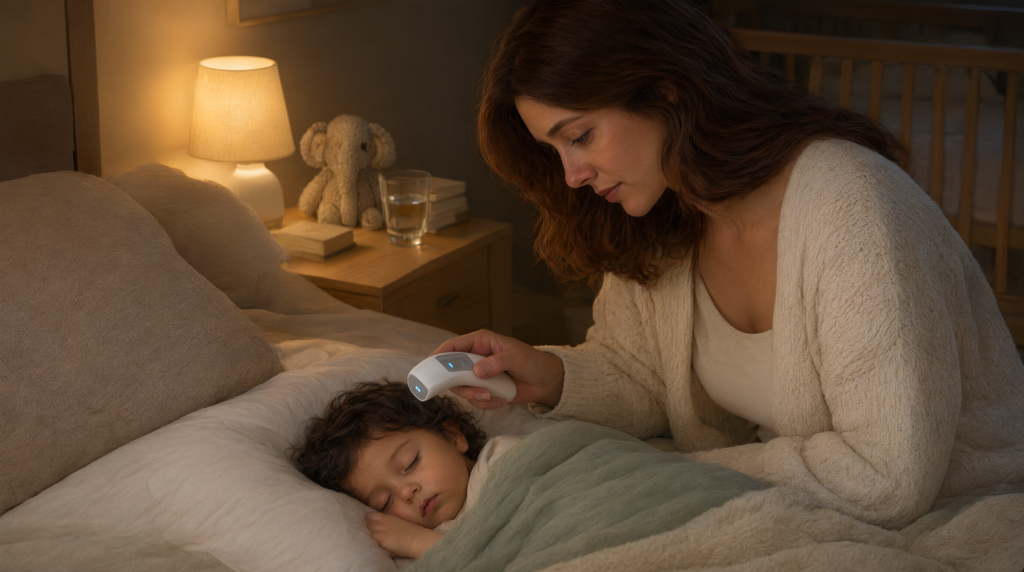
Common Causes: Viral Fever and Other Infections
Most fevers in children come from infections that the body clears on its own.
Viral fever and antibiotics
Viral fever is the most common cause. Colds, flu, throat infections and stomach bugs all raise body temperature. Antibiotics for viral fever do not help, because antibiotics work on bacteria and not viruses. Giving them without a doctor’s advice can cause side effects and can add to antibiotic resistance.
Teething and fever after vaccination
Teething: It can cause mild warmth, but it does not cause a true fever. If your teething baby has a temperature of 100.4°F or higher, look for another cause.
Vaccination: A mild fever after vaccination is common. It usually appears within a day or two and settles on its own. Call your doctor if it is high or lasts longer.
How to Reduce Fever at Home Safely
The goal at home is comfort, not a perfect number. Your child can rest, and the body can keep fighting the infection. Here is a simple routine you can follow tonight.
Do this:
- Give fluids often. Offer water, diluted juice or small sips of oral rehydration solution. If your child has vomiting or loose stools, ask your doctor about an oral rehydration solution first.
- Dress your child lightly. Heavy blankets trap heat. A thin cotton layer and a light sheet work better.
- Use paracetamol for fever only if your child is uncomfortable. Your pediatrician will tell you the right dose for your child’s weight. Never guess the dose.
- Try a lukewarm bath for fever comfort. It can feel soothing, but you do not need to chase a lower reading.
- Let your child rest. Sleep helps recovery, and you do not need to wake your child just to check the temperature.
Avoid this:
- Aspirin, which is linked to a rare but serious illness called Reye syndrome
- Cold baths and rubbing alcohol
- Ibuprofen in babies under 6 months, unless a doctor advises it
For example, if your 4-year-old is playing quietly and drinking water but feels hot, light clothing and fluids are usually enough. If the same child is limp and refuses to drink, that is a reason to call the doctor even if the temperature is lower.
| Your child is… | What it usually means | Your next step |
| Alert, drinking, playing a little | A common viral fever | Fluids, rest, light clothing |
| Fussy but comforted easily | Mild discomfort | Paracetamol as your doctor advised |
| Limp, very sleepy or hard to wake | Possible serious illness | Seek medical care now |
Febrile Seizures: What Parents Should Know
A febrile seizure can happen when a child’s temperature rises quickly. It looks frightening, but most simple febrile seizures are brief and do not harm the brain. They are most common between 6 months and 3 years of age. About 60 percent happen between 1 and 24 hours after the fever begins, according to the same pediatric reference.
If your child has a seizure:
- Stay calm and note the time.
- Lay your child on their side on a soft surface.
- Do not put anything in the mouth and do not hold the child down.
- Call emergency services if the seizure lasts longer than 5 minutes, or if your child does not wake up normally afterward.
Good to know: giving paracetamol does not prevent febrile seizures, according to American Academy of Pediatrics guidance. Use medicine for comfort, not for prevention.
Warning Signs: When to See a Doctor
Contact a pediatrician or go to the nearest hospital if your child has fever and any of these signs:
- Age under 3 months with a temperature of 100.4°F or higher
- Fever with stiff neck, severe headache or sensitivity to light
- Trouble breathing or fast, laboured breathing
- A rash that does not fade when you press it
- Signs of dehydration: no tears, dry mouth, or very few wet diapers
- A seizure that lasts more than 5 minutes
- Unusual sleepiness, confusion or irritability that does not settle
- A fever of 102°F or higher that lasts more than two days
- A fever for 5 days, or fever lasting more than 3 days in a child under 2
- A long-term health condition, such as sickle cell disease
Trust your instincts. You know your child best, and a quick call is never wasted.
When to See a Pediatrician in Chennai and OMR
If you live around Padur, Navalur, Kelambakkam or Sholinganallur, the pediatrics department at Supreme Hospitals can examine your child, find the cause of the fever and guide you on safe treatment. Parents often ask us whether a night fever needs a hospital visit. If your child shows any warning sign above, do not wait for morning.
Whether you are looking for a pediatrician in OMR Chennai, a child specialist in Padur, or a pediatric hospital in OMR, Supreme Hospitals is here to help. Families searching for a child doctor near Navalur or the best pediatrician in Chennai can book a visit through our website.
Frequently Asked Questions
Why does a child’s fever rise at night?
Body temperature rises naturally in the evening, and cortisol is often lower at night. Together with an active infection, this makes fevers look worse after dark.
Is it normal for a fever to go away in the morning?
Yes. Morning temperatures are often lower. The fever may return in the evening, so keep checking for a few days.
Is 100.4°F a fever?
Yes. A temperature of 100.4°F (38°C) or higher counts as a fever in children.
Can a 104 degree fever cause brain damage?
A fever from an ordinary infection does not cause brain damage. A 104 degree fever still needs a call to your doctor the same day.
Does teething cause fever?
Teething can cause mild warmth, but not a true fever. Look for another cause if your baby has a temperature of 100.4°F or higher.
Do antibiotics help viral fever?
No. Antibiotics do not treat viral infections. Use them only when a doctor prescribes them.
What should I do about fever after vaccination?
A mild fever for a day or two is common. Offer fluids, keep your child comfortable, and call your doctor if the fever is high or does not settle.
Conclusion
A child fever at night is stressful, but it is rarely dangerous. Most fevers come from viral infections, and your child’s body is doing its job. Focus on comfort, fluids and rest, watch how your child behaves, and learn the warning signs so you can act early. When you feel unsure, reach out to a doctor.
Your child’s health matters every hour. Talk to the pediatric team at Supreme Hospitals in Padur, OMR, and give your family the reassurance it deserves.
Author bio
Dr. Archana Kulasekaran, MBBS, MD (Paediatrics), is a paediatrician at Supreme Hospitals, Padur, OMR, Chennai. Her areas of focus are growth and development monitoring and immunization and child health. She works with parents to help them understand common childhood concerns, including fever, and to know when a child needs medical care. If your child has a fever that worries you, you can book an appointment with Dr. Archana Kulasekaran at Supreme Hospitals.
Dr. Rajkumar, MBBS, MS (OBG), FMAS, is a consultant at Supreme Hospitals, Padur, OMR, Chennai. His areas of focus are chronic pain management and palliative and terminal care support. He helps patients and families understand their options for managing long-term pain and for receiving comfort-focused care. If you or a family member needs guidance on pain or supportive care, you can book an appointment with Dr. Rajkumar at Supreme Hospitals.
Disclaimer: This article is for general information and does not replace medical advice. Always consult a qualified pediatrician about your child’s health.