


Expert Review by: Dr. K. Anand Manjunath
Credentials: MBBS, MD (Paediatrics), DM (Cardiology)
Department: Consultant – Cardiology & Paediatric Cardiology
Published: April 2026 | Topic: Orthopaedic Surgery & Joint Replacement
Knee replacement surgery has evolved significantly with the introduction of robotic technology. Patients today have access to more precise and less invasive treatment options.
Robotic knee replacement surgery benefits are becoming increasingly relevant as more people seek faster recovery and better long-term outcomes.
With rising cases of joint issues due to aging and lifestyle factors, understanding these advancements helps patients make informed decisions.
What Is Robotic Knee Replacement Surgery?
Robotic-assisted surgery uses advanced imaging and robotic guidance to improve the accuracy of joint replacement procedures.
Mako robotic-assisted surgery is one of the commonly used systems that allows surgeons to plan and execute procedures with high precision.
Key Benefits of Robotic Knee Replacement Surgery
Improved Precision and Alignment
Robotic systems reduce human error and help achieve accurate implant positioning. This leads to a reduction in alignment outliers, improving long-term outcomes.
Less Tissue Trauma
One of the major advantages is less tissue trauma in robotic-assisted surgery, which helps preserve surrounding muscles and ligaments.
Natural Knee Kinematics
The surgery aims to restore natural knee kinematics, allowing the joint to move more naturally after recovery.
Improved Joint Proprioception
Better alignment and tissue preservation contribute to improved joint proprioception, enhancing balance and movement control.
Faster Recovery and Mobilization
Modern approaches include rapid mobilization protocol, allowing patients to begin movement earlier.
Same-Day and Outpatient Options
Many patients are now eligible for same-day joint replacement or outpatient knee surgery, depending on their condition.
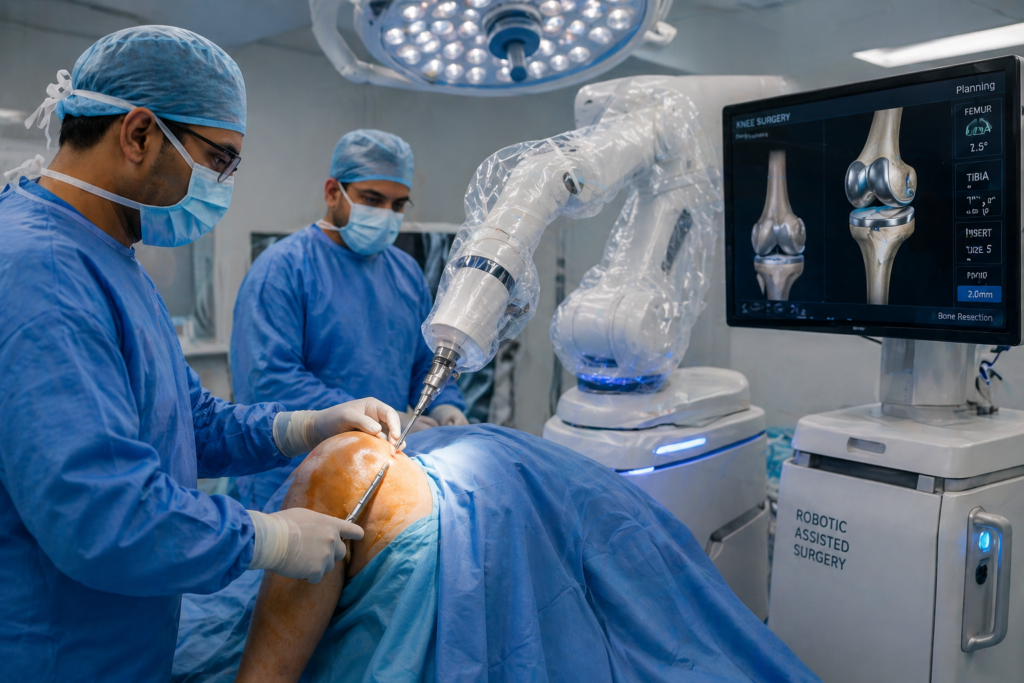
Robotic vs. Manual Knee Replacement: Recovery Time 2026
Robotic-assisted procedures generally offer faster recovery compared to traditional methods.
Patients often experience:
- Reduced pain
- Shorter hospital stay
- Faster return to daily activities
Walking Within 24 Hours After Robotic Knee Replacement
Early mobilization is a key advantage.
Many patients are able to start walking within 24 hours after robotic knee replacement under medical supervision, which improves recovery outcomes.
Is Robotic Knee Surgery Worth the Extra Cost?
This is a common concern among patients.
While robotic surgery may involve higher initial cost, the benefits such as reduced complications, faster recovery, and better alignment often provide long-term value.
Robotic-Assisted Total Knee Arthroplasty (TKA) Success Rates
Robotic-assisted total knee arthroplasty (TKA) success rates are generally high due to improved precision and consistency.
Better implant positioning and reduced surgical variability contribute to long-term joint stability.
Key Points
- Higher precision compared to manual surgery
- Reduced tissue damage
- Faster recovery and early mobility
- Better joint alignment and function
- Suitable for outpatient knee surgery in selected cases
- Improved long-term outcomes
When to See a Professional
- Persistent knee pain affecting daily activities
- Difficulty walking or climbing stairs
- Limited joint movement
- Knee deformity or instability
If symptoms interfere with daily life, a specialist evaluation is recommended.
How It Works
The process begins with imaging scans to create a 3D model of the knee.
The robotic system assists the surgeon in planning and executing the procedure with high precision, ensuring accurate implant placement.
Solutions / Practical Advice
Surgical Approach
- Robotic-assisted knee replacement
- Customized implant positioning
- Minimally invasive techniques
Post-Surgery Care
- Physiotherapy
- Pain management
- Gradual return to activity
Case Example
A 60-year-old patient presented with chronic knee pain for over a year, worsening with walking and daily activities. He also reported stiffness and reduced mobility.
His history included osteoarthritis and difficulty managing symptoms with medication and physiotherapy.
After evaluation, robotic-assisted knee replacement was recommended. Pre-surgical planning using imaging helped map the joint accurately.
The procedure was performed using Mako robotic-assisted surgery. Precise implant placement was achieved with minimal tissue disruption.
The patient began walking within 24 hours under supervision and followed a rapid mobilization protocol. He was discharged within a short duration with a structured rehabilitation plan.
At a 4-week follow-up, he reported significant pain relief and improved mobility, with the ability to perform daily activities comfortably.
What You Can Do Now
- Monitor knee pain and mobility issues
- Seek early evaluation for persistent symptoms
- Maintain a healthy weight
- Follow physiotherapy recommendations
- Discuss advanced surgical options if needed
Why This Matters
Advancements in joint replacement are improving patient outcomes significantly.
Understanding robotic knee replacement surgery benefits helps patients choose treatments that offer faster recovery, better function, and long-term joint health.
FAQs
It offers better precision, less tissue damage, faster recovery, and improved joint function.
Robotic surgery uses advanced technology for precise implant placement, while manual surgery relies on traditional techniques.
Yes, many patients can begin walking within 24 hours under medical supervision
It may cost more initially but often provides better outcomes and faster recovery.
Robotic-assisted TKA has high success rates due to improved accuracy and consistency.
